 Questions for Our Scientific Partners?

Neutrophils are the most abundant leukocyte in human blood and the first responders of the innate immune system, but they have long resisted the engineering tools that work routinely on T cells and NK cells. Three properties make them difficult.
First, neutrophils are short-lived. Circulating half-life is on the order of hours, so any workflow with multi-step isolation, washing, and overnight transfection consumes a meaningful fraction of usable cell life before the experiment begins.
Second, neutrophils are exquisitely sensitive to manipulation. Density-gradient isolation, magnetic bead separation, and even temperature shifts can pre-activate them, alter surface marker expression, and trigger NETosis. The act of getting them out of blood often changes the cells you wanted to study.
Third, conventional delivery methods are a poor fit. Lipid nanoparticles, with tropism dominated by hepatocyte uptake (apoE/LDLR-mediated) and lymphocyte targeting still in development, have not produced robust delivery data in primary granulocytes. Electroporation has historically struggled with viability in primary neutrophils relative to other immune cells. Viral vectors are largely impractical because neutrophils are terminally differentiated and short-lived, leaving little useful window for transduction or stable transgene expression.
The result is that the cargo space for functional studies in primary neutrophils (knockouts, reporters, probes, antibodies) has been narrower than in T cells or NK cells, and most published neutrophil work relies on cell lines (HL-60, PLB-985) or iPSC-derived granulocytes as surrogates.
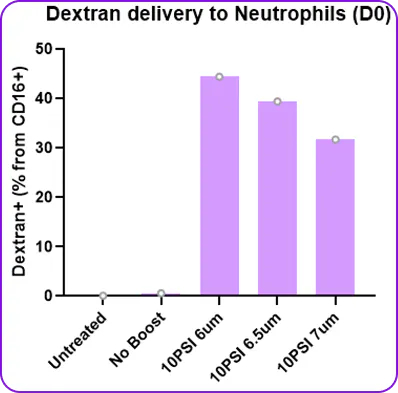
Portal mechanoporation delivered GFP circular RNA and a 3 kDa fluorescent dextran tracer to neutrophils inside unfractionated human whole blood, reaching ~50% GFP+ neutrophils the day after delivery and ~32% to ~44% dextran+ neutrophils the same day, while preserving the neutrophil population at ~95% of live cells post-boost.
The experiment used a single-step in-blood workflow. Whole blood was mixed with cargo (GFP circRNA plus dextran tracer, with an RNase inhibitor added for RNA stability in the blood matrix) and passed through a Portal MicroBooster™ cartridge at three chip sizes (6, 6.5, and 7 µm) at 10 PSI. No Ficoll, no magnetic beads, and no red-cell lysis were used upstream of the boost.
Two flow cytometry readouts were taken. Same-day, the CD16+ neutrophil population was gated for viability and dextran uptake. Next-day, the CD16+ / CD14- neutrophil population was gated for GFP expression.
Readout | Untreated / No-Cargo Controls | Boosted (best chip condition) |
|---|---|---|
Dextran+ neutrophils, D0 | ~0% | up to ~44% |
GFP+ neutrophils, D1 | ~0% | ~50% |
D0 PBMC viability | ~98% | ~98% |
D1 PBMC viability | ~80% | ~65%+ |
Neutrophil fraction of live cells, D0 | ~84% (no-boost) | ~95% |
Portal offers two instrument scales for circRNA delivery to primary T cells, both using the same mechanoporation principle with consistent performance metrics.
Portal's mechanoporation-based intracellular delivery platforms span cell therapy, gene editing, and drug discovery. The MicroBooster™ cartridge is the research-scale consumable that pairs with the Gateway benchtop instrument; the same mechanoporation principle is implemented at clinical scale by the MilliBooster cartridge integrated with instruments such as the Fresenius Kabi Lovo Cell Processing System, supporting workflows from 0.5M cells (research) to 1B+ cells (clinical manufacturing).
Mechanoporation delivers cargo by passing cells through precisely engineered constrictions in the cartridge. Controlled mechanical stress creates transient openings in the cell membrane, cargo in the surrounding solution diffuses into the cytosol, and the membrane self-heals within seconds.
Two properties of this mechanism make whole-blood delivery feasible. The first is that mechanoporation is cargo-agnostic and does not depend on receptor-mediated uptake or endosomal escape, both of which behave unpredictably in neutrophils. The second is that the workflow tolerates a complex matrix. Red cells, platelets, plasma proteins, and other leukocytes are all present during the boost, and the gated neutrophil population still picks up cargo at high frequency.
Because the boost happens before any isolation step, the neutrophils in the readout were never separated from their native blood environment. This avoids the pre-activation that isolation steps introduce, though activation marker readouts beyond CD16 / CD14 gating were not part of this experiment.
The Gateway system is a benchtop instrument designed for research workflows. For clinical manufacturing, the MilliBooster cartridge integrates with clinical cell processing systems, including the Fresenius Kabi Lovo Cell Processing System via a simple sterile weld or luer lock connection, enabling processing of 1B+ cells with validated GMP compatibility.
No specialized reagents are required beyond the circRNA constructs themselves. Mechanoporation eliminates the need for viral vectors, lipid nanoparticles, modified nucleotides, or electroporation buffers.
The workflow stays inside the blood matrix end-to-end. Unfractionated whole blood is mixed directly with the cargo (circRNA plus a fluorescent tracer for delivery confirmation), passed through a MicroBooster™ cartridge in seconds to minutes, and read out by flow cytometry without any intervening isolation step. Tracer uptake on the gated neutrophil population is visible the same day; GFP expression from circRNA accumulates over the following day, separating cargo entry from translation.
The same in-blood mechanoporation workflow is cargo-agnostic and extends beyond circRNA. Portal mechanoporation has been used across cell types for delivery of:
For neutrophils specifically, this opens a cargo space that has historically been hard to access. RNPs enable transient knockouts in a cell type that cannot be expanded in culture and is poorly suited to lentiviral transduction. Antibodies and small-molecule probes enable target validation studies in resting primary neutrophils rather than surrogate cell lines.
Circular RNA was chosen for this experiment specifically because of its extended expression window. Portal's circRNA application note reports expression up to 10 days in primary T cells, compared to the typical 24 to 48 hours for linear mRNA. For short-lived cell types like neutrophils, this wider window provides flexibility on the timing of phenotypic, functional, or imaging readouts after delivery.
The neutrophil result above is one node of a broader in-blood engineering platform. The same workflow (whole blood in, MicroBooster™ cartridge, no isolation) has been used to engineer other immune populations directly from blood, with the cargo determining which cell type gets the readout.
For T cells, Portal mechanoporation co-delivered CD19 CAR circRNA and mbIL-2 mRNA into whole blood and produced 50%+ CD19 CAR+ / mbIL-2+ double-positive T cells in under 10 minutes. No apheresis, no T cell isolation, no cleanroom upstream of the boost.
For mixed peripheral blood mononuclear cells (PBMCs), the same platform delivered GFP mRNA across all major subpopulations in parallel (T cells CD3+, B cells CD19+, NK cells CD56+, and monocytes CD14+) with ~75% viability and successful expression in every gated lineage, without pre-selecting any of them.
Target Population in Whole Blood | Cargo | Headline Result |
|---|---|---|
Neutrophils (CD16+ / CD14-) | GFP circRNA + dextran | ~50% GFP+ at D1, ~32% to ~44% dextran+ at D0 |
T cells (CAR-T from whole blood) | CD19 CAR circRNA + mbIL-2 mRNA | 50%+ CAR+ / mbIL-2+ in <10 min, 300x+ over control |
PBMCs (T, B, NK, monocyte) | GFP mRNA | Expression in all four subpopulations, ~75% viability, no pre-selection |
The practical implication for a neutrophil-focused program is that an in-blood neutrophil readout does not require a separate platform decision. The same instrument, consumable, and workflow scale into co-engineering studies, mixed-lineage assays, or whole-blood cell therapy programs as the science calls for them.
Three application areas line up directly with the data:
Can you deliver CRISPR RNPs to primary neutrophils with this workflow?
The same in-blood mechanoporation platform has delivered CRISPR RNPs in other primary immune cells (including 85%+ triple-positive delivery of RNP, mRNA, and dextran in unstimulated T cells). Conditions for RNP delivery to neutrophils in whole blood are an active area of work. Reach out if RNP is your target cargo.
Does the boost activate neutrophils?
The boost did not selectively deplete neutrophils, and the CD16+ neutrophil fraction of live cells was actually slightly higher in boosted samples (~95%) than in the no-boost control (~84%). Activation marker readouts beyond CD16 / CD14 gating were not part of this experiment. For activation-sensitive studies, we recommend running paired activation panels alongside delivery readouts.
Does the workflow work on frozen blood or only fresh?
The data shown here used fresh unfractionated whole blood. Performance on frozen or stabilized blood can be evaluated as part of conditions optimization for a specific application.
How does this compare to electroporation of isolated neutrophils?
Direct head-to-head comparisons in primary human neutrophils were not run in this experiment. The motivating advantage of mechanoporation in whole blood is that the isolation step (which itself can pre-activate neutrophils and trigger NETosis) is skipped entirely.



 Back
Back